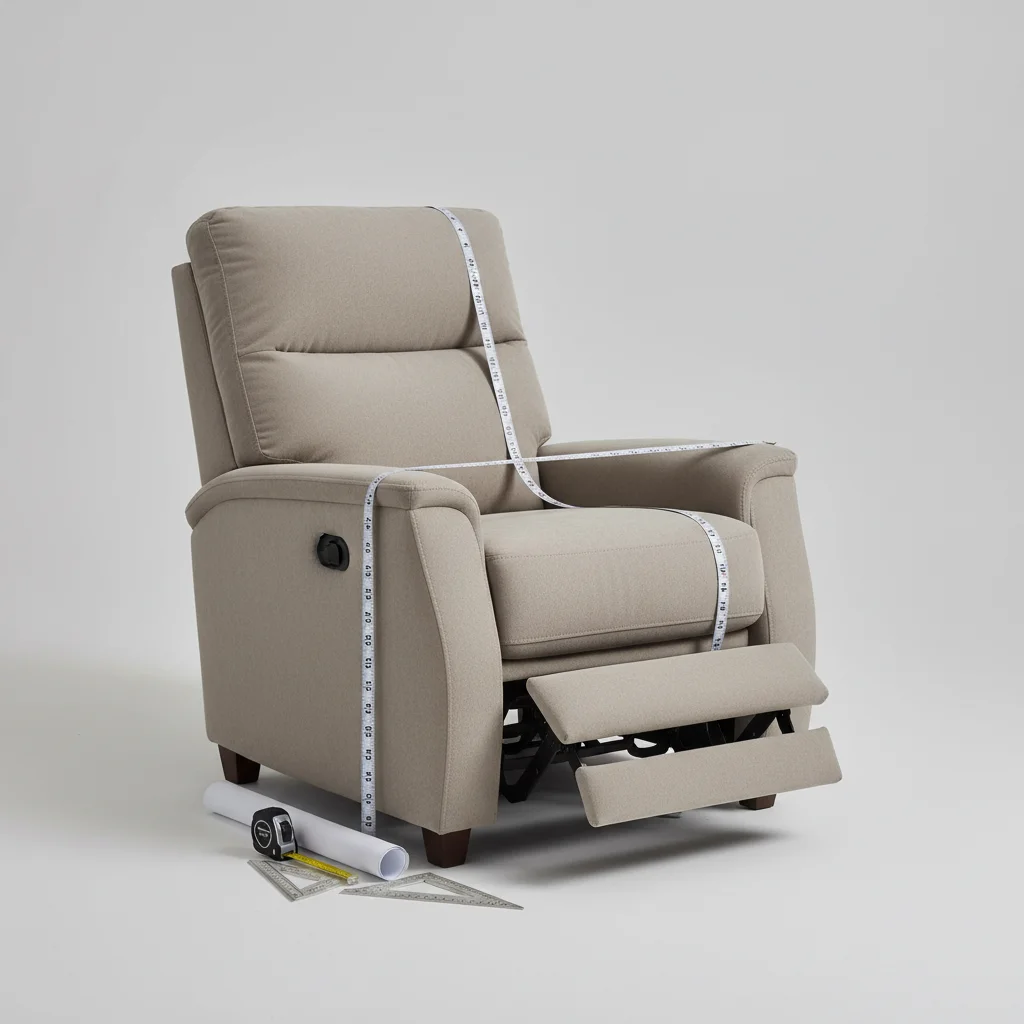
Understanding recliner chair dimensions is crucial for ensuring a comfortable fit in your home. There are typically three main categories of recliner sizes: standard, compact, and oversized, each designed to accommodate different body types and room layouts. Choosing the correct dimensions prevents overcrowding a room and guarantees the recliner provides optimal support for the user.
Standard Recliner Dimensions Explained
Standard recliners generally measure between 35 to 40 inches in width, 35 to 40 inches in depth when upright, and 40 to 45 inches in height. When fully reclined, these chairs can extend to a depth of 65 to 70 inches. This size is ideal for average-sized adults and living rooms with ample space. It’s important to measure not just the chair itself, but also the clearance needed for the reclining mechanism, especially if it’s not a wall-hugger model.
Compact Recliners for Smaller Spaces
For apartments, small living rooms, or bedrooms, compact recliners are an excellent choice. These often feature widths ranging from 28 to 34 inches, depths of 30 to 35 inches when upright, and heights of 38 to 42 inches. Their reclined depth is typically around 60 to 65 inches. Wall-hugger compact recliners are particularly beneficial as they require only 4-6 inches of clearance from a wall, maximizing floor space.
Oversized Recliners for Enhanced Comfort
|
Our Picks for the Best Recliner Chair in 2026
As an Amazon Associate I earn from qualifying purchases.
|
||
| Num | Product | Action |
|---|---|---|
| 1 | Power Recliner Chair for Adults with Massage and Heat, Swivel Oversized Leather Recliner Chair with USB Ports & Side Pockets for Living Room (22" Medium-Seat Width,Gray) |

|
| 2 | MCombo Dual Motor Large Power Lift Recliner Chair for Elderly, Lay Flat Lift Chair with Heat and Massage, Big Lift Recliner for Tall People, Cup Holders, Fabric 7896 (Large, Dark Gray) |
|
| 3 | Plush Linen Fabric Massage Rocker Recliner Chair Oversized Design with Manual Massage and Heat Two Cup Holders and USB Port for Living Room (Blue) |
|
| 4 | Tiita Lazy Chair with Ottoman, Gray Modern Large Accent Chair, Comfy Leisure Sofa Armchair with Ottoman, Reading Chair with Footrest for Bedroom, Living Room, Dorm Rooms, Garden Dark Grey |
|
| 5 | Garvee Elertric Recliner Chair with Memory Function PU Leather, Adjustable Single Recliners Sofa with Remote Control for Adults, Home Theater Seating &Armchair for Living Room/Office |
|
| 6 | MAXYOYO Accent Chair with Ottoman Adjustable Backrest, Tufted Living Room Chair Upholstered Lounge Chair with Footrest Set, Modern Chair Cozy Reclining Chair for Reading Room, Green |
|
| 7 | Garvee Elertric Recliner Chair with Memory Function Adjustable Single Recliners Sofa with Remote Control for Adults, Home Theater Seating &Armchair for Living Room/Office (Light Khaki, Fabric) |
|
| 8 | Signature Design by Ashley Foreside Contemporary Nuvella Manual Rocker Recliner with Head-Neck Support and Pillow-Top Arms, Gray |
|
| 9 | Lazy Chair with Ottoman, Large Dark Grey Accent Chair with Ottoman, Comfy Reading Armchair, Leisure Sofa Chair for Living Room, Bedroom, Dorm Room, Office |
|
| 10 | Recliner Chair,Electric Adjustable Chenille Recliner with Remote Control and Padded Backrest,Home Theater Recliner Single Sofa Seat with Thick Seat Cushion for Living Room Bedroom (Grey) |
|
Oversized recliners, sometimes referred to as ‘big and tall’ recliners, are designed for larger individuals or those who prefer extra room. These chairs can be 40 to 50 inches wide, 40 to 45 inches deep when upright, and 45 to 50 inches high. When fully reclined, their depth can reach 70 to 75 inches or more. They often feature wider seats and higher weight capacities, typically supporting up to 350-500 pounds, compared to the 250-300 pounds of standard recliners.
Measuring Your Space Before You Buy
Before purchasing any recliner, accurately measure the intended space. Consider the width of doorways and hallways for delivery, as well as the area where the recliner will sit. Use painter’s tape on the floor to outline the recliner’s footprint, both upright and fully reclined, to visualize how it will fit and ensure there’s enough room for other furniture and foot traffic. Don’t forget to account for any side tables or lamps that might be placed next to the recliner.
- Measure the width of your doorway and any hallways for delivery.
- Determine the available floor space for the recliner in both upright and reclined positions.
- Consider the height of the recliner in relation to windows or wall decor.
- Account for necessary wall clearance, especially for non-wall-hugger models.
- Ensure there’s enough room for foot traffic around the recliner.
Specialty Recliner Dimensions
Beyond the standard categories, specialty recliners like lift recliners or swivel recliners may have unique dimensional considerations. Lift recliners, for instance, often have a slightly larger base to accommodate the lifting mechanism, while swivel recliners require clear space around their entire circumference to allow for full rotation. Always check the manufacturer’s specific dimensions for these specialized models to avoid any surprises.
Get our weekly buyer guide
Practical specs, not advice. Unsubscribe anytime.
