Experiencing persistent neck pain can significantly impact daily comfort and overall well-being. Whether it’s from long hours at a desk, poor posture, or simply the stresses of modern life, the nagging discomfort often makes true relaxation elusive. While traditional seating often exacerbates the issue, an ergonomically designed recliner chair can offer a powerful solution, providing the targeted support needed to alleviate strain and promote healing. This comprehensive guide, informed by over a decade of specialized experience with recliner chairs, will demystify the features and considerations crucial for selecting the perfect ergonomic recliner to transform your downtime into a truly restorative experience, specifically targeting neck pain relief.
Recliner Chairs: Overview and Benefits
Recliner chairs are more than just comfortable seats; they are sophisticated pieces of furniture designed to support the body in various positions, offering both relaxation and therapeutic benefits. Understanding their mechanism and advantages is key to appreciating their role in alleviating neck pain.
What is a Recliner Chair?
|
Our Picks for the Best Recliner Chair in 2026
As an Amazon Associate I earn from qualifying purchases.
|
||
| Num | Product | Action |
|---|---|---|
| 1 | MCombo Dual Motor Large Power Lift Recliner Chair for Elderly, Lay Flat Lift Chair with Heat and Massage, Big Lift Recliner for Tall People, Cup Holders, Fabric 7896 (Large, Dark Gray) |

|
| 2 | Lazy Chair with Ottoman, Large Dark Grey Accent Chair with Ottoman, Comfy Reading Armchair, Leisure Sofa Chair for Living Room, Bedroom, Dorm Room, Office |
|
| 3 | Garvee Elertric Recliner Chair with Memory Function Adjustable Single Recliners Sofa with Remote Control for Adults, Home Theater Seating &Armchair for Living Room/Office (Light Khaki, Fabric) |
|
| 4 | Power Recliner Chair for Adults with Massage and Heat, Swivel Oversized Leather Recliner Chair with USB Ports & Side Pockets for Living Room (22" Medium-Seat Width,Gray) |
|
| 5 | Recliner Chair,Electric Adjustable Chenille Recliner with Remote Control and Padded Backrest,Home Theater Recliner Single Sofa Seat with Thick Seat Cushion for Living Room Bedroom (Grey) |
|
| 6 | Garvee Elertric Recliner Chair with Memory Function PU Leather, Adjustable Single Recliners Sofa with Remote Control for Adults, Home Theater Seating &Armchair for Living Room/Office |
|
| 7 | Plush Linen Fabric Massage Rocker Recliner Chair Oversized Design with Manual Massage and Heat Two Cup Holders and USB Port for Living Room (Blue) |
|
| 8 | Tiita Lazy Chair with Ottoman, Gray Modern Large Accent Chair, Comfy Leisure Sofa Armchair with Ottoman, Reading Chair with Footrest for Bedroom, Living Room, Dorm Rooms, Garden Dark Grey |
|
| 9 | Signature Design by Ashley Foreside Contemporary Nuvella Manual Rocker Recliner with Head-Neck Support and Pillow-Top Arms, Gray |
|
| 10 | MAXYOYO Accent Chair with Ottoman Adjustable Backrest, Tufted Living Room Chair Upholstered Lounge Chair with Footrest Set, Modern Chair Cozy Reclining Chair for Reading Room, Green |
|
A recliner chair is an armchair that tilts back when the occupant lowers the chair’s back and raises its front. This mechanism allows the user to recline into a comfortable, often semi-supine position. Modern recliner chairs have evolved significantly, moving beyond basic manual levers to include advanced features like power recline, adjustable headrests, and integrated massage functions. The core principle remains the same: to provide customizable comfort that adapts to the body’s natural contours, supporting overall well-being.
Benefits of Using a Recliner Chair
The advantages of an ergonomic recliner chair extend far beyond simple comfort, particularly for those suffering from neck pain.
- Improved Posture and Reduced Back Pain: Proper lumbar support, often adjustable, ensures the natural curve of the lower spine is maintained. This support helps align the entire spine, from the lower back up to the neck, reducing the strain on muscles and joints. When the lower back is correctly supported, it prevents slouching, which is a major contributor to neck and upper back discomfort.
- Relaxation and Stress Reduction: The ability to recline and elevate the legs can significantly reduce pressure on the spine and improve blood circulation. This full-body support allows muscles to relax fully, easing tension that often accumulates in the neck and shoulders due to stress. Some recliners even offer a gentle rocking motion, further enhancing a sense of calm and promoting deeper relaxation.
- Enhanced Blood Circulation: Elevating the legs above heart level, especially in a zero-gravity position, can improve blood flow throughout the body. Better circulation can reduce swelling and relieve pressure, which in turn can contribute to overall comfort and reduce muscle stiffness, including in the neck.
Types of Recliner Chairs
Recliner chairs come in various forms, each offering distinct features and mechanisms. Choosing the right type depends on your specific needs, mobility, and desired level of adjustability.
According to Operating Mechanism
The way a recliner operates directly impacts its ease of use and the precision of its adjustments.
- Manual Recliner Chairs: These are the traditional choice, often operated by a lever or simply by pushing back with your body weight. They are generally more affordable and don’t require electrical outlets, making them versatile in terms of placement. However, they may offer fewer reclining positions and require some physical effort to adjust.
- Power Recliner Chairs: Offering smooth, effortless adjustments with the push of a button, power recliners provide precise control over the recline angle, headrest, and often lumbar support. This is particularly beneficial for individuals with limited mobility or those seeking exact positioning for neck pain relief. Some advanced models include memory settings, allowing you to save your preferred positions.
- Lift Recliner Chairs: Designed primarily for individuals with mobility challenges, lift recliners gently tilt forward to assist the user in standing up and lowering themselves back into the seat. Many also offer full recline functionality, providing comfort alongside crucial assistance. These often come with power mechanisms for easy operation.
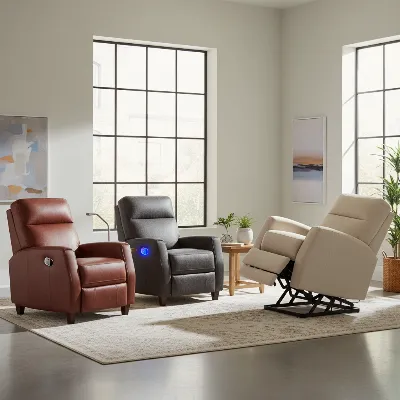 Various recliner chairs demonstrating different operating mechanisms, including manual lever, power buttons, and lift function.
According to Material
The choice of material affects not only the aesthetic appeal of a recliner but also its durability, maintenance, and overall feel.
- Leather Recliner Chairs: Leather offers a luxurious look, durability, and is often easy to clean. Genuine leather can last for many years with proper conditioning. It adapts to body temperature, feeling cool in summer and warm in winter. However, it can be a significant investment.
- Fabric Recliner Chairs: Available in a vast array of colors, patterns, and textures, fabric recliners offer versatility in design and can be softer to the touch. Performance fabrics are particularly popular for their stain-resistant and durable qualities, making them ideal for homes with pets or children. Regular cleaning may be required depending on the fabric type.
- Faux Leather Recliner Chairs: Faux leather provides the look and feel of genuine leather at a more budget-friendly price point. It’s generally easy to clean and maintain, offering a good balance of durability and stain resistance. However, it may not be as breathable or as long-lasting as high-quality genuine leather.
According to Design Style
Recliners are no longer confined to bulky, traditional designs. Modern innovations mean they can seamlessly integrate into various home decor styles.
- Modern Recliner Chairs: Characterized by sleek lines, minimalist profiles, and often hidden reclining mechanisms, modern recliners prioritize aesthetic elegance without compromising comfort. They frequently feature sophisticated upholstery and compact designs suitable for contemporary living spaces.
- Classic Recliner Chairs: These chairs embrace traditional aesthetics, often with overstuffed cushions, rolled arms, and exposed wood accents. They evoke a sense of timeless comfort and often become a cozy centerpiece in a more traditional setting.
- Multi-functional Recliner Chairs: Beyond standard reclining, these chairs might include features like swivel bases, rocking capabilities, heat therapy, or massage functions. They are designed to provide a comprehensive relaxation experience, catering to various needs from soothing a baby to alleviating muscle tension.
Comparison Table of Recliner Chairs
Selecting the ideal recliner involves weighing the pros and cons of different types. This table offers a quick comparison to help you match features with your priorities.
| Feature / Type | Manual Recliner | Power Recliner | Lift Recliner |
|---|---|---|---|
| Mechanism | Body weight / Lever | Electric motor | Electric motor (lift assist) |
| Ease of Adjustment | Moderate (some effort) | Very easy (button-controlled) | Very easy (button-controlled) |
| Precision | Limited preset positions | Infinite positions, precise | Infinite positions, precise |
| Mobility Support | Low | Moderate | High (standing assist) |
| Cost | Low to Mid | Mid to High | Mid to High |
| Power Requirement | None | Yes | Yes |
| Neck Pain Benefit | Relies on good headrest | Highly customizable support | Customizable, aids standing |
| Pros | Affordable, no power needed | Smooth, precise, feature-rich | Mobility assist, feature-rich |
| Cons | Less adjustability, effort | Higher cost, power needed | Higher cost, larger footprint |
When considering materials, leather offers luxury and durability, fabric provides variety and softness, and faux leather is a cost-effective, easy-to-clean alternative. The “best” choice depends on your lifestyle, budget, and aesthetic preferences. For targeted neck pain relief, the adjustability of headrest and lumbar support is often more critical than the material or mechanism type.
How to Choose an Ergonomic Recliner Chair (Buying Guide)
Choosing the best ergonomic recliner chair for neck pain relief requires careful consideration of personal needs and specific features. Here’s a structured approach to guide your decision.
Determine Your Usage Needs
Before diving into options, clarify who will use the chair and for what purpose.
- Who will use the chair? Consider the primary user’s height, weight, and any specific physical conditions, such as chronic neck or back pain. A recliner that fits one person perfectly might be uncomfortable for another.
- For what purpose will the chair be used? Are you looking for a chair for reading, watching TV, napping, or active work? Different activities require different levels of support and adjustability. For prolonged use, such as reading or working, precise adjustments for head and lumbar support are paramount.
- What is your budget? Recliner chairs range widely in price. Establishing a budget early will help narrow down your options without compromising essential ergonomic features. Remember, an investment in a quality ergonomic recliner is an investment in your health and comfort.
Key Factors to Consider
Several critical features contribute to a recliner’s ergonomic effectiveness, especially for neck pain.
- Size and Space: Measure your designated area, including the space needed for the recliner to fully recline. Ensure there’s adequate clearance behind and around the chair. An ill-fitting chair can disrupt room flow and may not allow full functionality. Your body size should also match the chair’s dimensions, ensuring your feet can rest flat and your knees are at a comfortable 90-degree angle when seated upright.
- Material and Durability: Opt for high-quality materials that can withstand daily use. Look for durable upholstery like performance fabrics or genuine leather. Frame construction should be sturdy, often made of hardwood or steel, to ensure longevity and consistent support. High-density foam or memory foam cushioning is crucial as it adapts to your body’s contours and resists sagging over time, maintaining supportive qualities for your neck and back.
- Features and Ergonomics:
- Adjustable Headrest: This is arguably the most crucial feature for neck pain relief. Look for headrests that allow customization of height and angle to support the occipital ridge and maintain neutral neck alignment, preventing awkward craning. Memory foam headrests are highly recommended for their conforming support.
- Lumbar Support: Essential for maintaining the natural inward curve of your lower back, which in turn supports the entire spine. Adjustable lumbar support allows you to customize the pressure and position to fit your unique spinal curve, reducing strain that can radiate to the neck.
- Reclining Mechanism: Power recliners offer precise control over angles, which is ideal for finding the “sweet spot” (often between 110 and 130 degrees for spinal relief, or a zero-gravity position that distributes weight evenly).
- Cushioning: High-density memory foam is superior as it conforms to your body, providing consistent support without breaking down. Avoid overly soft fillers that can lead to slouching.
- Armrests: Ensure armrests are at a comfortable height to support your arms and shoulders, reducing tension that can travel up to your neck.
- Footrest Length: The footrest should extend sufficiently to support your legs and feet without putting strain on your knees, promoting better circulation.
Tips for Testing a Recliner Chair Before Purchase
Whenever possible, test recliners in person to truly assess comfort and fit.
- Check the Mechanism: If it’s a manual recliner, test the lever and how smoothly it operates. For power recliners, evaluate the responsiveness of the buttons and the quietness of the motor. Ensure transitions between positions are fluid.
- Inspect Materials and Stitching: Look for high-quality upholstery, even stitching, and solid construction. These indicators speak to the recliner’s overall durability and the manufacturer’s attention to detail.
- Sit and Recline for Comfort: Spend at least several minutes in each recliner. Pay close attention to how your neck, shoulders, and lower back feel. Can you achieve a neutral spinal alignment? Does the headrest support your neck without pushing your head forward? Test various reclining positions to ensure you can find one that alleviates pressure points and feels genuinely comfortable for extended periods.
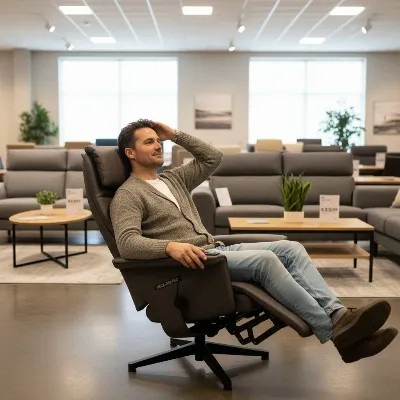 A person testing the comfort and ergonomic features of an ergonomic recliner chair in a showroom.
Top Picks: Ergonomic Recliner Features for Neck Pain Relief
While specific model availability can vary, several features consistently appear in top-rated ergonomic recliners beneficial for neck pain. Focus on these characteristics when evaluating options.
- Adjustable Power Headrests: Recliners offering power-adjustable headrests are highly favored. Brands like Flexsteel and La-Z-Boy often incorporate these, allowing users to fine-tune the headrest angle for optimal neck alignment. This precision is crucial for preventing strain during various activities like reading or watching TV.
- Zero-Gravity Recline Functionality: Many top models incorporate a zero-gravity position, which elevates the feet above the heart. This posture evenly distributes body weight, reducing pressure on the spine and neck. MCombo and some specialized ergonomic brands are known for offering this feature, providing profound relief for chronic pain sufferers.
- Integrated Lumbar Support Systems: Whether it’s adjustable air bladders or well-contoured memory foam, superior lumbar support is a hallmark of the best ergonomic recliners. This feature works synergistically with the headrest to maintain proper spinal alignment, which is foundational for neck pain relief.
- High-Density Memory Foam Cushioning: Recliners with premium high-density memory foam in the seat, back, and headrest provide excellent support that molds to the body without sagging. This material ensures lasting comfort and maintains its supportive qualities, preventing the “bottoming out” feeling that can lead to poor posture.
- Smooth Power Recline Mechanisms: For effortless transitions and precise positioning, power recliners are often preferred. Look for quiet motors and intuitive controls that allow for infinite recline angles, making it easy to find the most comfortable and pain-relieving position.
When making your selection, consider how these features align with your specific needs. An investment in a recliner with these ergonomic elements can significantly improve your quality of life, offering a dedicated space for relief and relaxation.
Maintenance and Cleaning of Recliner Chairs
Proper care and maintenance are essential for extending the life of your ergonomic recliner and ensuring it continues to provide optimal support for neck pain relief. Different materials require specific cleaning approaches.
How to Clean Different Materials
- Leather: For general cleaning, wipe leather recliners with a soft, damp cloth. Use a specialized leather cleaner and conditioner every 6-12 months to keep the leather supple and prevent cracking. Always test cleaning products on an inconspicuous area first. Avoid harsh chemicals, as they can damage the finish.
- Fabric: Regularly vacuum fabric recliners using an upholstery attachment to remove dust and debris. For spills, blot immediately with a clean, dry cloth. For deeper cleaning, consult the manufacturer’s care label. Many fabric types can be spot-cleaned with a mild fabric cleaner, but some may require professional upholstery cleaning.
- Faux Leather: Faux leather is generally very easy to clean. Wipe with a damp cloth and mild soap solution for most spills and dirt. Avoid abrasive cleaners or brushes, which can damage the surface. Dry thoroughly after cleaning.
Tips for Maintaining Your Recliner Chair
Beyond cleaning, regular maintenance can preserve your recliner’s functionality and comfort.
- Avoid Direct Sunlight: Prolonged exposure to direct sunlight can fade upholstery and dry out leather, leading to premature wear. Position your recliner away from windows or use curtains/blinds to protect it.
- Use Specialized Care Products: For leather, use conditioners designed to keep it moisturized. For fabrics, consider protective sprays (if compatible) that can repel stains.
- Regularly Inspect and Lubricate Mechanisms: For manual recliners, periodically check for loose bolts or connections and tighten them as needed. For both manual and power recliners, if you notice any squeaking or stiffness, a silicone-based lubricant can often resolve the issue. Refer to your owner’s manual for specific lubrication points.
- Rotate Cushions (if applicable): If your recliner has removable cushions, rotating and flipping them periodically can help maintain their shape and prevent uneven wear, ensuring consistent support.
- Protect from Pets and Sharp Objects: Pets can cause significant damage to upholstery. Use throws or covers to protect your recliner from scratches and fur. Be mindful of sharp objects like buckles or jewelry that could snag or tear the material.
By following these maintenance guidelines, your ergonomic recliner chair will remain a comfortable and supportive haven for many years, continuing to provide effective neck pain relief.
Conclusion
Choosing the best ergonomic recliner chair for neck pain relief is a decision that significantly impacts your daily comfort and long-term well-being. We’ve explored how crucial features like adjustable headrests, robust lumbar support, and advanced reclining mechanisms work together to alleviate strain and promote proper spinal alignment. From understanding the various types and materials to implementing effective cleaning and maintenance routines, the journey to finding your ideal recliner is an investment in a healthier, more relaxed lifestyle. With the right knowledge, you can confidently select a recliner chair that serves as your ultimate sanctuary for comfort and therapeutic support.
Are you ready to transform your relaxation experience and finally find lasting relief from neck pain?
Frequently Asked Questions
What makes a recliner specifically good for neck pain?
A recliner is good for neck pain primarily due to its adjustable headrest, which allows you to customize the angle and height to properly support your cervical spine. Excellent lumbar support is also key, as it helps align the entire back, reducing overall tension that can affect the neck.
Can a zero-gravity recliner help with neck pain?
Yes, a zero-gravity recliner can be highly beneficial for neck pain. By elevating your legs above your heart, it evenly distributes your body weight, reducing pressure on your spine and neck. This position helps decompress the vertebrae and allows neck muscles to relax, alleviating discomfort.
What kind of cushioning is best for neck pain relief in a recliner?
High-density memory foam cushioning is considered best for neck pain relief. Unlike softer fillers, memory foam conforms to your body’s natural curves, providing consistent, stable support for your head, neck, and back without sagging over time.
How important is adjustable lumbar support for neck pain?
Adjustable lumbar support is extremely important for neck pain. The spine is interconnected, and proper support for your lower back maintains overall spinal alignment. This reduces strain on the muscles and ligaments in your lower back, preventing compensatory tension that often leads to neck pain.
Should I choose a manual or power recliner for neck pain?
For optimal neck pain relief, a power recliner is often recommended over a manual one. Power recliners offer precise, effortless adjustments of the recline angle and headrest, allowing you to find the exact position that minimizes neck strain without physical effort.
